About the patent
Troibox is listed in the US Patent Office database under ID US11691808B2 - Dual purpose intermodal tank container. It is a modification of an existing Standard Oil patent for a multi-compartment tank.
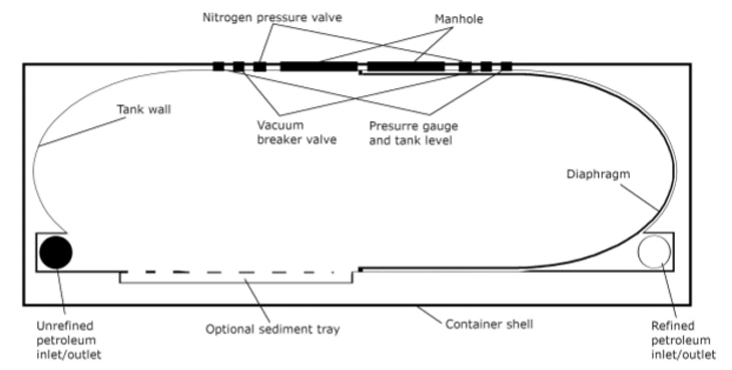
- Consists of Tank container (TroiBox) - Pump (TroiPump) - Marine Vessel (TroiShip)
- Is made of composite materials - low weight (8% weight advantage vs. DOT117 cars)
- TroiBox is based on low tare weight (composite tank), low dilution Ratio (5% toluene) and heat retention (4 inch PUR foam insulation)
- Has inner diaphragm to divide low and high viscosity fluids, which supplies push effect while unloading and allows refined liquid backhaul
Advantages of containerized oil transport
- New exporting chanel beside pipelines and CrudeByRail(CBR)
- No need for permanent facilities, everything is intermodal, mobile
- Possibility to enter refined products market in Canada and US (backhaul of fuels)
- Merges the refined/unrefined liquid stream with existing cargo container streams, reduction of deadheading
- Offers custom blended product for refiners/customers without refinery infrastructure alteration
- Smaller production facilities, TroiBox can load unrefined liquids with up to 3.5% solids
Environmental benefits
- Equalizes weight in Asia <-> North America container streams. Improves utilization of railway and marine transportation resources by 75%
- Solves empty container repositioning problem, ships can load up to full DWT capacity thus not cruising seas with water in ballast tanks
- Can accept crude oils with high percentage of impurities, too sour, waxy etc. Crude oil production facilities can be smaller and less CO2 intensive
- Allows backhaul of refined fuels on the same route, eliminating need for dual ship voyage
- Works within current cargo container infrastructure, eliminating need for new facilities in coastal areas
- Low dilution ratio and heat retention allows transporting bitumen as non-dangerous goods
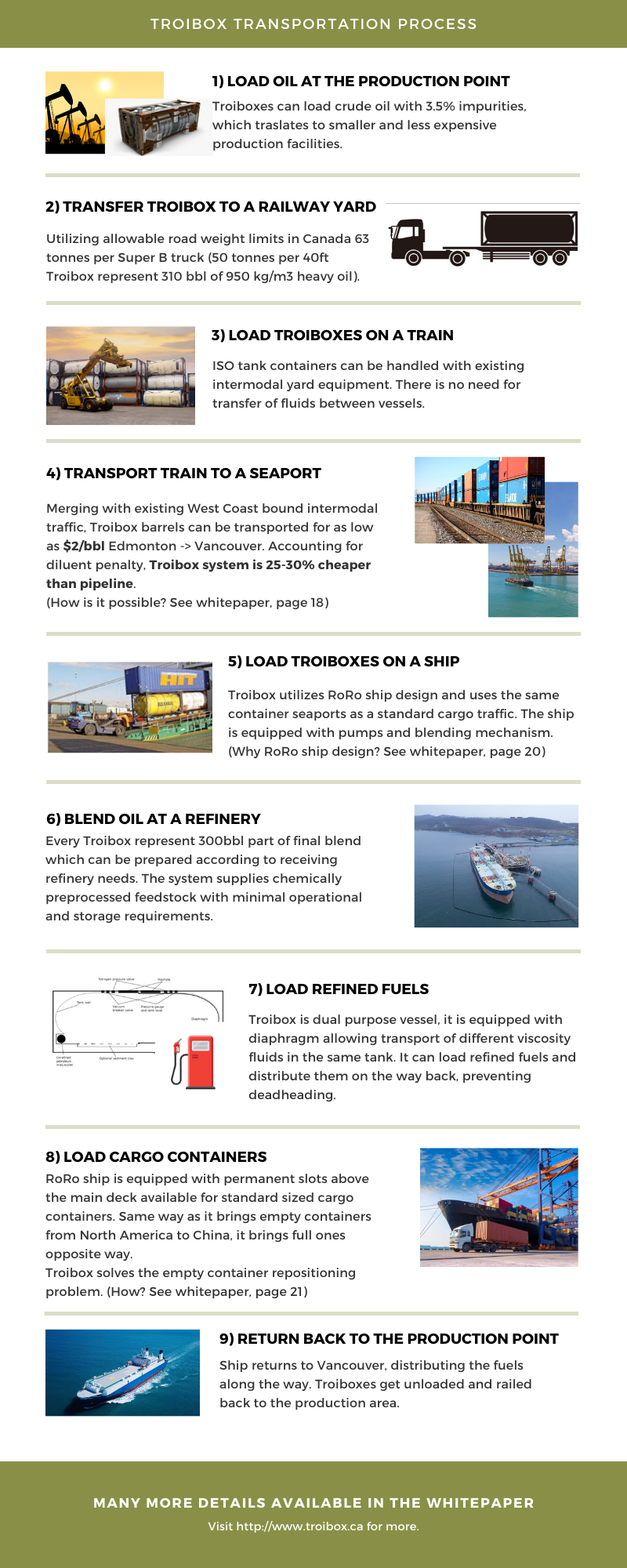
Troibox crude oil container transportation process
FAQ
How does Troibox differ from other containerized methods?
It is transportation of refinery feedstock in liquid form. There is no need for diluent recovery facilities or any other alterations on the refinery-receiving side. It makes implementation way easier since any refinery infrastructure changes are very expensive.
Standard CrudeByRail(CBR) is proven option to pipelines. Does Troibox offer something new?
The major difference is absence of fluid transloading facilities. It has major implications especially in West Coast areas known for "Not In My Backyard" policies. Troibox is mobile, intermodal solution.
Is the crude oil transported in flamable form?
Transported crude oil has low dilution ratio of up to 5% toluene mixed with bitumen. It renders the cargo as nonflamable goods as specified by DOT. Using the tank heat retention capability its possible to keep the fluid in liquid form all the way to the destination.
Isn't the system moving too much steel around in the form of tare weight of the tank containers?
Recent advances in material manufacturing allows to build the tanks from composite materials which are about 50% lighter compared to steel. Its true that such system would consist of many thousands of tank containers, which would need to be carefully tracked. Hoyer group has approx. 35000 units worldwide. Troibox would need comparable number of tanks to secure 600.000 bbl/day export chanel to Asia. But, even when accounting for the building of new TroiShips, its still cheaper than building a pipeline.
There is also diluent factor in transport of heavy crude oils such Western Canadian Select(WCS). WCS is blend of bitumen mixed with 30-40% condensates (very light fractions of crude oil). These condensates represent deadweight in any pipeline transport involving extra heavy crude oil.
Isn't the Troibox too heavy for road transport?
In Canada, highest possible GVW is 63 tonnes. Which allows one 40ft (FEU) Troibox on a truck. USA are way more strict in regards of allowable road limits, many states have maximum 80.000 lbs (36 tonnes) limit per unit. Such restriction would allow Troibox to operate in USA just in 20ft (TEU) size.
Biofuel
West Coast refineries are turning into biofuel plants.
https://www.jwnenergy.com/article/2020/8/13/massive-oil-refiners-are-turning-biofuel-plants-we/
The LCFS credits as well as federal RIN D5 credits and recently reintroduced Blenders Tax Credits generate up to $3.32 a gallon in subsidies for renewable diesel producers across the US.
Using chemical process called transesterification, its possible to turn biorefinery feedstock as tallows, vegetable oils and used cooking oils into biofuels.
Troibox offers excellent solution for transportation of the unrefined /refined liquids, since there is no specialized pipeline infrastructure, for handling the biofuel feedstocks and products.